Center for East Asian Studies ‘East Asia Now’ Series Brings AI Pioneer Corey Jaskolski to Campus
The Center for East Asian Studies (CEAS) kicked off a new installment of their popular “East Asia Now” series earlier this month with a talk about the global surveillance implications of the 2023 Chinese spy balloon and how a Wisconsin-based AI company successfully tracked its movements. Held in the Orchard View Room at the Wisconsin Institute for Discovery, the event was co-sponsored by the Wisconsin Science Festival, the College of Letters and Science, and the School of Computer, Data and Information Sciences, as part of the broader Wisconsin RISE initiative.Speaker Corey Jaskolski, CEO and founder of RAIC Labs, captivated the packed house when he discussed his company’s integral role in tracking the Chinese spy balloon. Jaskolski’s Wisconsin roots and impressive career journey resonated with the audience, particularly the UW students in attendance.A graduate of UW-Stevens Point, Jaskolski built an accomplished career, becoming an MIT-trained engineer, a National Geographic fellow and explorer, and a successful entrepreneur. Despite his global accomplishments, he has remained dedicated to the UW community, generously committing time and resources to assist several student projects. His company, headquartered right here in Wisconsin, serves a wide array of fields, from national security to conservation, wildlife protection, and the discovery of artifacts and ruins.Jaskolski’s presentation centered on how RAIC Labs utilized their Rapid Automated Image Categorization (RAIC) AI product to track the high-altitude balloon across millions of square miles of unlabeled satellite data. The tracking analysis revealed that the balloon carried a payload the size of two buses, weighing about 2,000 pounds, with equipment designed to intercept communications and geolocate radio frequency emitters. Attendees were attentive to every detail as he brought this complex subject to life.“In a period when the hype surrounding AI (really machine learning) has reached ludicrous proportions, Corey and RAIC have built something that actually works, which can do things that no human analyst or object detection model was capable of doing in the past,” said David Fields, associate director for the Center for East Asian Studies. “I have had the opportunity to use RAIC in the past several months on various research projects, and its abilities are astounding.”The success of the “East Asia Now” series event demonstrates CEAS’s commitment to exploring the intersections of East Asian policy, technology, and global security. Keep up with the CEAS on Facebook and Instagram or visit their website for upcoming events.Story by Kayla Daum
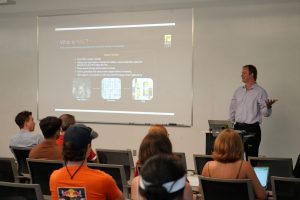 The Center for East Asian Studies (CEAS) kicked off a new installment of their popular “East Asia Now” series earlier this month with a talk about the global surveillance implications of the 2023 Chinese spy balloon and how a Wisconsin-based AI company successfully tracked its movements. Held in the Orchard View Room at the Wisconsin Institute for Discovery, the event was co-sponsored by the Wisconsin Science Festival, the College of Letters and Science, and the School of Computer, Data and Information Sciences, as part of the broader Wisconsin RISE initiative.
Speaker Corey Jaskolski, CEO and founder of RAIC Labs, captivated the packed house when he discussed his company’s integral role in tracking the Chinese spy balloon. Jaskolski’s Wisconsin roots and impressive career journey resonated with the audience, particularly the UW students in attendance.
A graduate of UW-Stevens Point, Jaskolski built an accomplished career, becoming an MIT-trained engineer, a National Geographic fellow and explorer, and a successful entrepreneur. Despite his global accomplishments, he has remained dedicated to the UW community, generously committing time and resources to assist several student projects. His company, headquartered right here in Wisconsin, serves a wide array of fields, from national security to conservation, wildlife protection, and the discovery of artifacts and ruins.
Jaskolski’s presentation centered on how RAIC Labs utilized their Rapid Automated Image Categorization (RAIC) AI product to track the high-altitude balloon across millions of square miles of unlabeled satellite data. The tracking analysis revealed that the balloon carried a payload the size of two buses, weighing about 2,000 pounds, with equipment designed to intercept communications and geolocate radio frequency emitters. Attendees were attentive to every detail as he brought this complex subject to life.
“In a period when the hype surrounding AI (really machine learning) has reached ludicrous proportions, Corey and RAIC have built something that actually works, which can do things that no human analyst or object detection model was capable of doing in the past,” said David Fields, associate director for the Center for East Asian Studies. “I have had the opportunity to use RAIC in the past several months on various research projects, and its abilities are astounding.”
The success of the “East Asia Now” series event demonstrates CEAS’s commitment to exploring the intersections of East Asian policy, technology, and global security. Keep up with the CEAS on Facebook and Instagram or visit their website for upcoming events.
Story by Kayla Daum
The Center for East Asian Studies (CEAS) kicked off a new installment of their popular “East Asia Now” series earlier this month with a talk about the global surveillance implications of the 2023 Chinese spy balloon and how a Wisconsin-based AI company successfully tracked its movements. Held in the Orchard View Room at the Wisconsin Institute for Discovery, the event was co-sponsored by the Wisconsin Science Festival, the College of Letters and Science, and the School of Computer, Data and Information Sciences, as part of the broader Wisconsin RISE initiative.
Speaker Corey Jaskolski, CEO and founder of RAIC Labs, captivated the packed house when he discussed his company’s integral role in tracking the Chinese spy balloon. Jaskolski’s Wisconsin roots and impressive career journey resonated with the audience, particularly the UW students in attendance.
A graduate of UW-Stevens Point, Jaskolski built an accomplished career, becoming an MIT-trained engineer, a National Geographic fellow and explorer, and a successful entrepreneur. Despite his global accomplishments, he has remained dedicated to the UW community, generously committing time and resources to assist several student projects. His company, headquartered right here in Wisconsin, serves a wide array of fields, from national security to conservation, wildlife protection, and the discovery of artifacts and ruins.
Jaskolski’s presentation centered on how RAIC Labs utilized their Rapid Automated Image Categorization (RAIC) AI product to track the high-altitude balloon across millions of square miles of unlabeled satellite data. The tracking analysis revealed that the balloon carried a payload the size of two buses, weighing about 2,000 pounds, with equipment designed to intercept communications and geolocate radio frequency emitters. Attendees were attentive to every detail as he brought this complex subject to life.
“In a period when the hype surrounding AI (really machine learning) has reached ludicrous proportions, Corey and RAIC have built something that actually works, which can do things that no human analyst or object detection model was capable of doing in the past,” said David Fields, associate director for the Center for East Asian Studies. “I have had the opportunity to use RAIC in the past several months on various research projects, and its abilities are astounding.”
The success of the “East Asia Now” series event demonstrates CEAS’s commitment to exploring the intersections of East Asian policy, technology, and global security. Keep up with the CEAS on Facebook and Instagram or visit their website for upcoming events.
Story by Kayla Daum