Design, Consumption, and Connection at the Latest Wisconsin International Resource Consortium Workshop
The Wisconsin International Resource Consortium (WIRC), a collaboration among the nine UW–Madison area studies centers, recently hosted a workshop titled “Design and Consumption: Mechanisms of Conveying Information.” This interdisciplinary workshop for K-12 and community college educators explored the historical roots of artistic expression and its influence on today’s digital information landscape.The workshop featured speakers who connected historical context with contemporary relevance. Gabrielle Cornish, assistant professor of musicology at UW–Madison’s Mead Witter School of Music, discussed the ways we apply meaning to music, including sound, emotion, and text. Cornish linked historical musical movements to broader societal narratives, offering participants a deeper comprehension of how information is conveyed through sound.Next, Blue Rachapradit, a Thai interdisciplinary visual artist and MFA candidate at UW–Madison, introduced an interactive element to the workshop. Rachapradit’s session explored feminist themes through a surreal aesthetic and encouraged participants to engage in a novel way. Attendees were invited to sit on the floor, each holding a single piece of tissue with a neighbor. This approach led participants to actively engage and move from their seats while prompting meaningful connection and dialogue. Rachapradit explained it was to enable participants to “hold hands without actually holding hands,” demonstrating a unique way to facilitate human interaction and communication.Kevin Nute, an architectural theorist and professor of architecture at the University of Hawaiʻi at Māno, presented after a short lunch break. Drawing from his work on Frank Lloyd Wright’s architecture and its relationship to place, time, and being, Nute offered fresh insights into how physical design emits information and shapes experiences. He explored how Wright’s time in Japan and interest in Japanese woodblock prints influenced his later architectural work, in particular his trademark emphasis on natural elements.His discussion provided a link between historical architectural principles and their presence in modern consumption patterns.After spending most of the day engaging in presentations about various designs and ways to communicate individuality, European Studies Outreach Specialist Eleanor Conrad closed out the workshop with a brief presentation on additional resources that describe how conformity is communicated, using the example of various mediums, including textile, landscape design, and typeface. “When we originally settled on the theme, we were excited by the interdisciplinary potential for this event,” said Andrea Fowler, WIRC chair and Center for South Asia assistant director. “The final program—music, art, architecture, and fonts—provided a well-rounded exploration of the theme. Each presenter found ways to tie into the other topics and highlight those interdisciplinary connections.”Check out the Wisconsin International Resource Consortium page for more information about the consortium and other upcoming events!
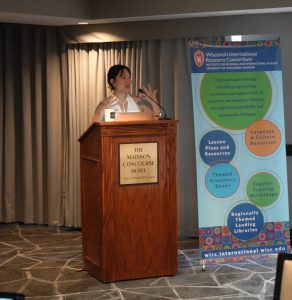 The Wisconsin International Resource Consortium (WIRC), a collaboration among the nine UW–Madison area studies centers, recently hosted a workshop titled “Design and Consumption: Mechanisms of Conveying Information.” This interdisciplinary workshop for K-12 and community college educators explored the historical roots of artistic expression and its influence on today’s digital information landscape.
The workshop featured speakers who connected historical context with contemporary relevance. Gabrielle Cornish, assistant professor of musicology at UW–Madison’s Mead Witter School of Music, discussed the ways we apply meaning to music, including sound, emotion, and text. Cornish linked historical musical movements to broader societal narratives, offering participants a deeper comprehension of how information is conveyed through sound.
The Wisconsin International Resource Consortium (WIRC), a collaboration among the nine UW–Madison area studies centers, recently hosted a workshop titled “Design and Consumption: Mechanisms of Conveying Information.” This interdisciplinary workshop for K-12 and community college educators explored the historical roots of artistic expression and its influence on today’s digital information landscape.
The workshop featured speakers who connected historical context with contemporary relevance. Gabrielle Cornish, assistant professor of musicology at UW–Madison’s Mead Witter School of Music, discussed the ways we apply meaning to music, including sound, emotion, and text. Cornish linked historical musical movements to broader societal narratives, offering participants a deeper comprehension of how information is conveyed through sound.
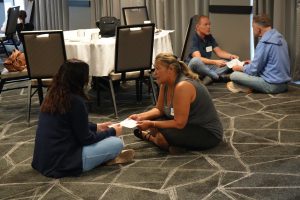 Next, Blue Rachapradit, a Thai interdisciplinary visual artist and MFA candidate at UW–Madison, introduced an interactive element to the workshop. Rachapradit’s session explored feminist themes through a surreal aesthetic and encouraged participants to engage in a novel way. Attendees were invited to sit on the floor, each holding a single piece of tissue with a neighbor. This approach led participants to actively engage and move from their seats while prompting meaningful connection and dialogue. Rachapradit explained it was to enable participants to “hold hands without actually holding hands,” demonstrating a unique way to facilitate human interaction and communication.
Kevin Nute, an architectural theorist and professor of architecture at the University of Hawaiʻi at Māno, presented after a short lunch break. Drawing from his work on Frank Lloyd Wright’s architecture and its relationship to place, time, and being, Nute offered fresh insights into how physical design emits information and shapes experiences. He explored how Wright’s time in Japan and interest in Japanese woodblock prints influenced his later architectural work, in particular his trademark emphasis on natural elements. His discussion provided a link between historical architectural principles and their presence in modern consumption patterns.
After spending most of the day engaging in presentations about various designs and ways to communicate individuality, European Studies Outreach Specialist Eleanor Conrad closed out the workshop with a brief presentation on additional resources that describe how conformity is communicated, using the example of various mediums, including textile, landscape design, and typeface.
Next, Blue Rachapradit, a Thai interdisciplinary visual artist and MFA candidate at UW–Madison, introduced an interactive element to the workshop. Rachapradit’s session explored feminist themes through a surreal aesthetic and encouraged participants to engage in a novel way. Attendees were invited to sit on the floor, each holding a single piece of tissue with a neighbor. This approach led participants to actively engage and move from their seats while prompting meaningful connection and dialogue. Rachapradit explained it was to enable participants to “hold hands without actually holding hands,” demonstrating a unique way to facilitate human interaction and communication.
Kevin Nute, an architectural theorist and professor of architecture at the University of Hawaiʻi at Māno, presented after a short lunch break. Drawing from his work on Frank Lloyd Wright’s architecture and its relationship to place, time, and being, Nute offered fresh insights into how physical design emits information and shapes experiences. He explored how Wright’s time in Japan and interest in Japanese woodblock prints influenced his later architectural work, in particular his trademark emphasis on natural elements. His discussion provided a link between historical architectural principles and their presence in modern consumption patterns.
After spending most of the day engaging in presentations about various designs and ways to communicate individuality, European Studies Outreach Specialist Eleanor Conrad closed out the workshop with a brief presentation on additional resources that describe how conformity is communicated, using the example of various mediums, including textile, landscape design, and typeface.
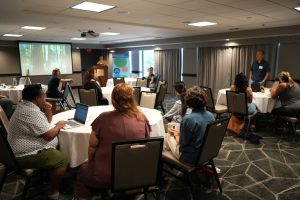 “When we originally settled on the theme, we were excited by the interdisciplinary potential for this event,” said Andrea Fowler, WIRC chair and Center for South Asia assistant director. “The final program—music, art, architecture, and fonts—provided a well-rounded exploration of the theme. Each presenter found ways to tie into the other topics and highlight those interdisciplinary connections.”
Check out the Wisconsin International Resource Consortium page for more information about the consortium and other upcoming events!
“When we originally settled on the theme, we were excited by the interdisciplinary potential for this event,” said Andrea Fowler, WIRC chair and Center for South Asia assistant director. “The final program—music, art, architecture, and fonts—provided a well-rounded exploration of the theme. Each presenter found ways to tie into the other topics and highlight those interdisciplinary connections.”
Check out the Wisconsin International Resource Consortium page for more information about the consortium and other upcoming events!